

Digging In
Channeling the rage closer to home.

I can’t tell you how many drafts I have started here over the last few months. Photos are imported, a few words typed out, and then I close out the window and barely even come back to this app/website to read all of the subscriptions I have piling up. For some reason it seems too trivial to bother with—the writing, the reading.
Right this moment I’m resisting the urge to do exactly what I wrote in the first two sentences.
What I have been doing, some of which I have written about in these sporadic posts the last few months, is reading a lot. I like to keep track of how much I read each year and participate in the yearly Goodreads challenge, and so I am at 26/60 books so far. Are a significant portion of them audiobooks? Yes. My piles of paper books practically scold me as I walk by them every day and yet I can’t seem to force myself to slow down enough to read them.
I’m also reacquainting myself with my neglected garden beds and some other greater yard projects. I lost a lot of interest in managing those spaces in the last four or five years and finally feel like I have the capacity to deal with those again. My long term goal for the summer is to remove most of the taro (Colocasia esculenta) along our portion of pond shoreline. It lines the entire pond and will come back eventually because it grows on the creek upstream that feeds into our pond. Whenever we have any significant flows (like Tuesday when we received about 6” of rain in 2 hours) loose plants will end up in the pond and possibly re-root along our shoreline. That, and it requires a shovel and significant upper body strength to wrestle the roots from the sticky mud. Many times I end up snapping off the leaves and the bulb stays stuck in the mud. My energy levels after digging for a while depends on how much effort I will make to dig out the detached bulb or just opt to move on to another plant and hope to revisit that one at some future date. This is a slow process and I have only done about 10’ of shoreline over the course of two nights of 30-45 minutes work each. My husband has tackled this project at least twice in the last decade and it always looks fabulous for a few years but inevitably the taro re-appears and we’re faced with this task yet again.
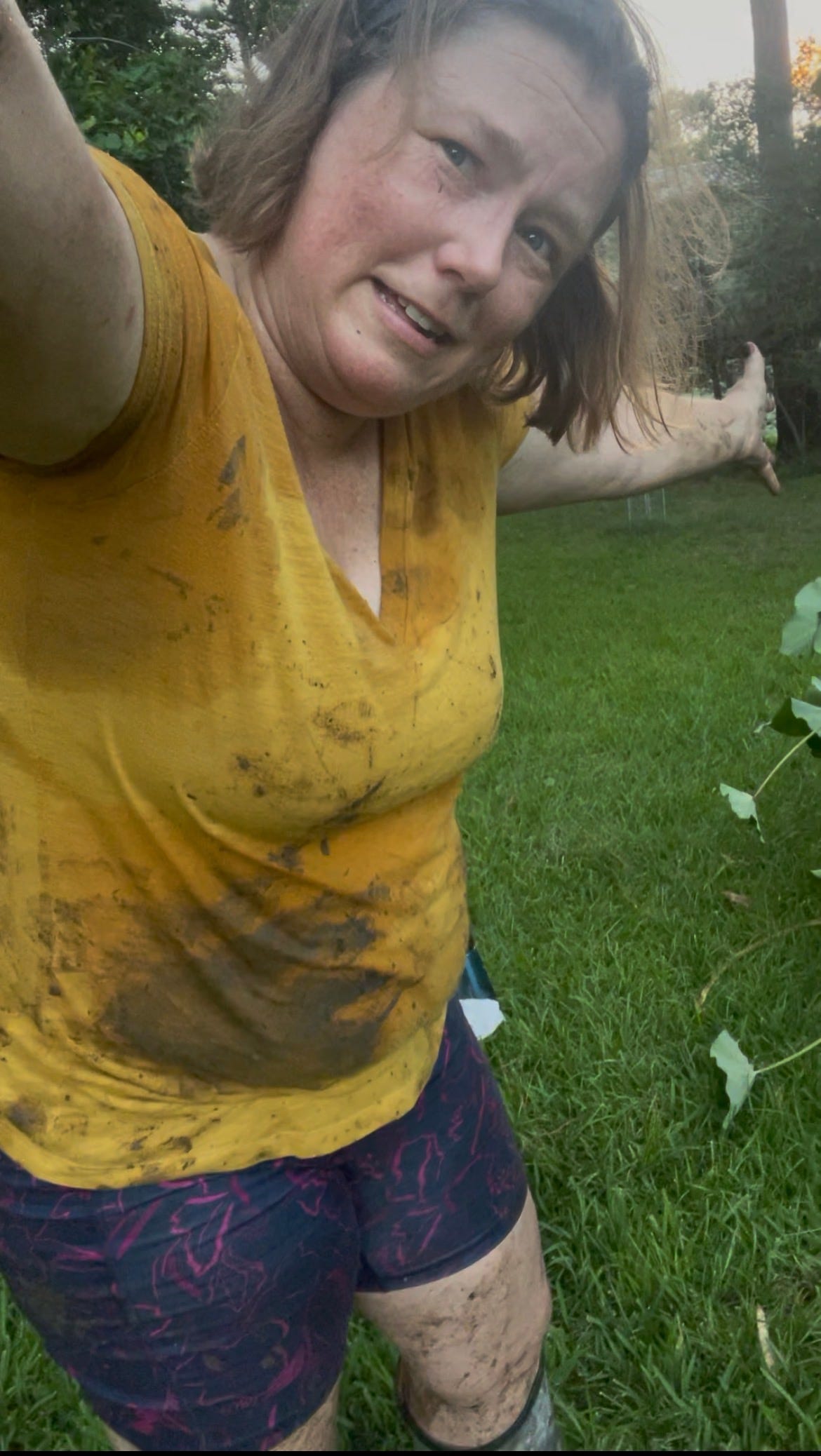
The other homeowners along the pond, and another pond in our city, continue to want to attempt to take the easy way out and spray the taro and well, just about any other plant that they deem as weedy. They’ve sprayed the spatterdock (Nuphar advena) a few times but, of course, it continues to live on. At least the spatterdock is native and is incredibly beneficial to fish and other aquatic species and I personally love seeing it. The taro are not native and crowd out other native vegetation along the shoreline but also does not always respond well to appropriately applied herbicide and sometimes requires stronger herbicides applied multiple times. I struggle with trying to communicate to my neighbors about the benefits of leaving much of the native plants alone and try to dissuade them from wanting to indiscriminately spray herbicides, particularly when the most of them can’t differentiate between native and non-native plants. Sometimes they listen, many times they lean on the cultural message they’ve all been given for decades: native plants are messy, clean lines and short-mown grasses are desirable. The reality is that the majority of them aren’t going to do what I’m doing, which is manual labor. Everyone wants the easy way out. (BTW: digging, bending, and pulling taro is an excellent oblique workout! ouch)
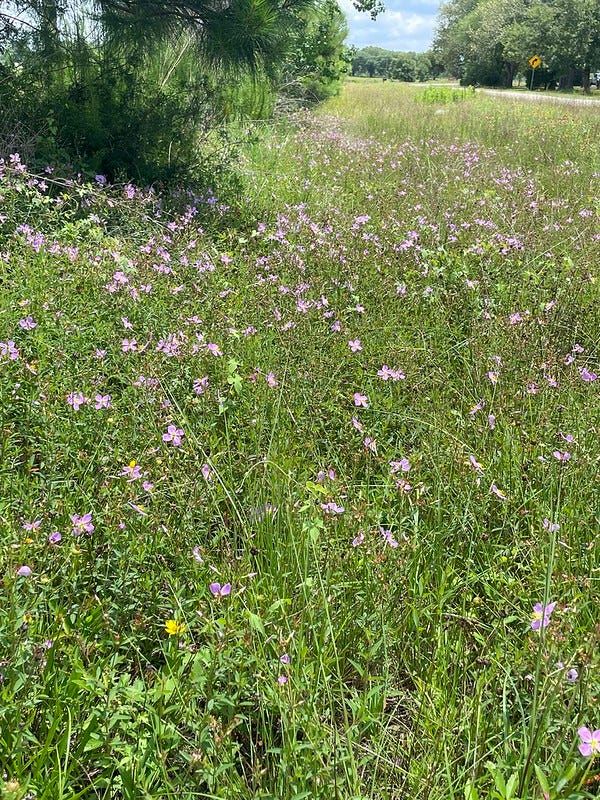
My other routine is to botanize/iNat several times a week during my lunch break. I’ve taken to hitting up a few select sites repeatedly over the course of a few months to see what is popping up throughout the seasons. I’ve had a handful of cemeteries on my list for several years now but have recently isolated several roadside areas on Google Earth to check out that have proven fruitful.
On one of these roadside trips recently, I created a new loop with a few sites to park roadside and walk. That loop ended with a stop at a gas station for an iced tea and cookie and is down the street from one of these cemeteries. I was last there in April with my husband and we’d botanized behind the gas station, too. There’s another gas station on the opposite corner and behind it was a large field, where on the north end stood a house that was probably from the 1940s or early 1950s. Directly behind the gas station lived a large, spreading live oak (Quercus virginiana) that I loved to look at it but never went to scope out because it was clearly not part of the property of the gas station (and I had also looked on the property appraiser map to verify). There were a couple of large loblolly pines (Pinus taeda) further back in the field and some other live oaks, too.


Imagine my shock when I pulled into the gas station after that little loop a few weeks ago and stood there in astonishment that everything on that property across the street had been razed, including the 100+ year old spreading live oak. I never once saw a For Sale sign but apparently that meant nothing. Fill had been brought in and the elevation had already been raised several feet. I wished I had gone and meandered through that field because spring wildflower season was usually pretty great from what I could see from across the street.
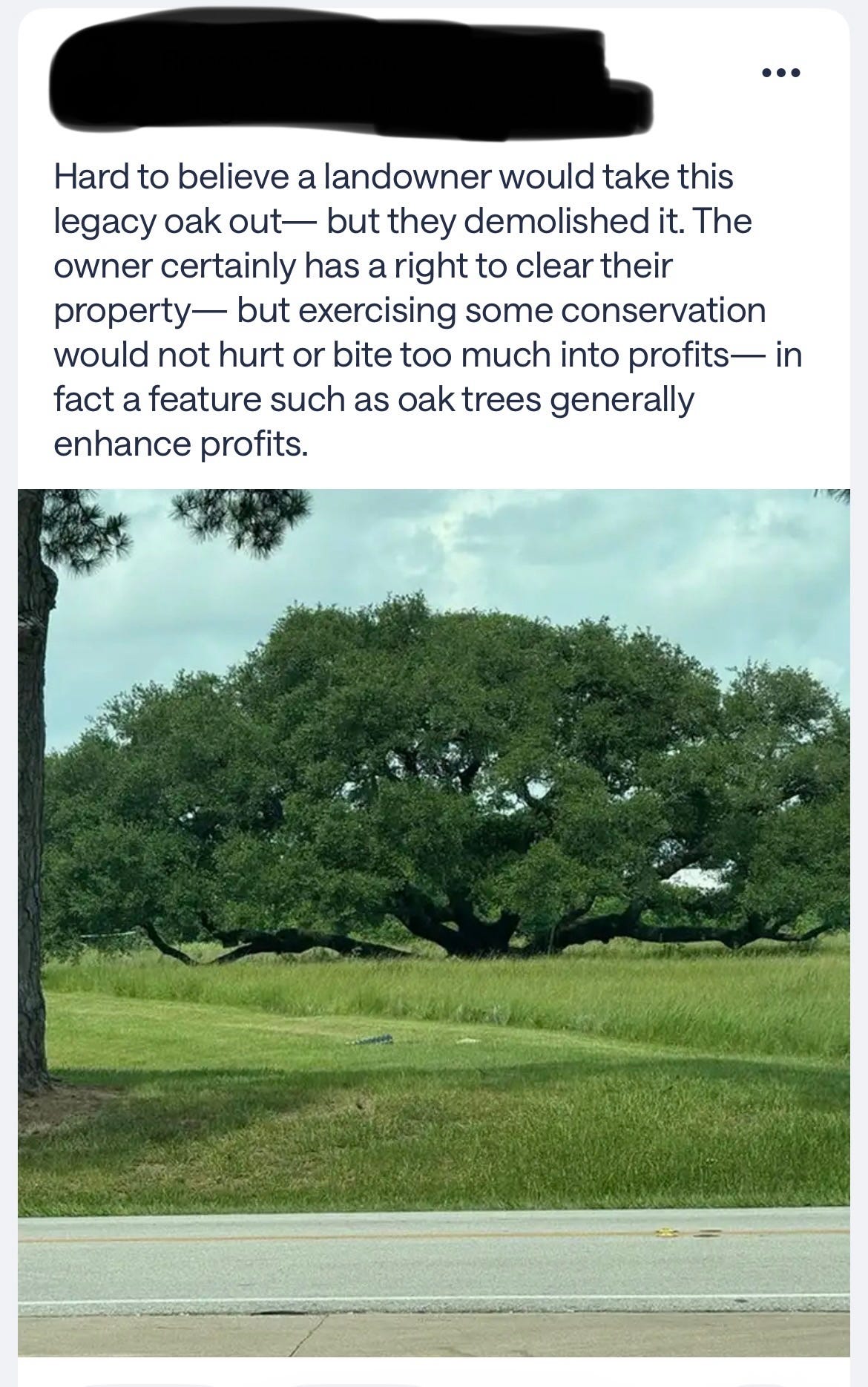
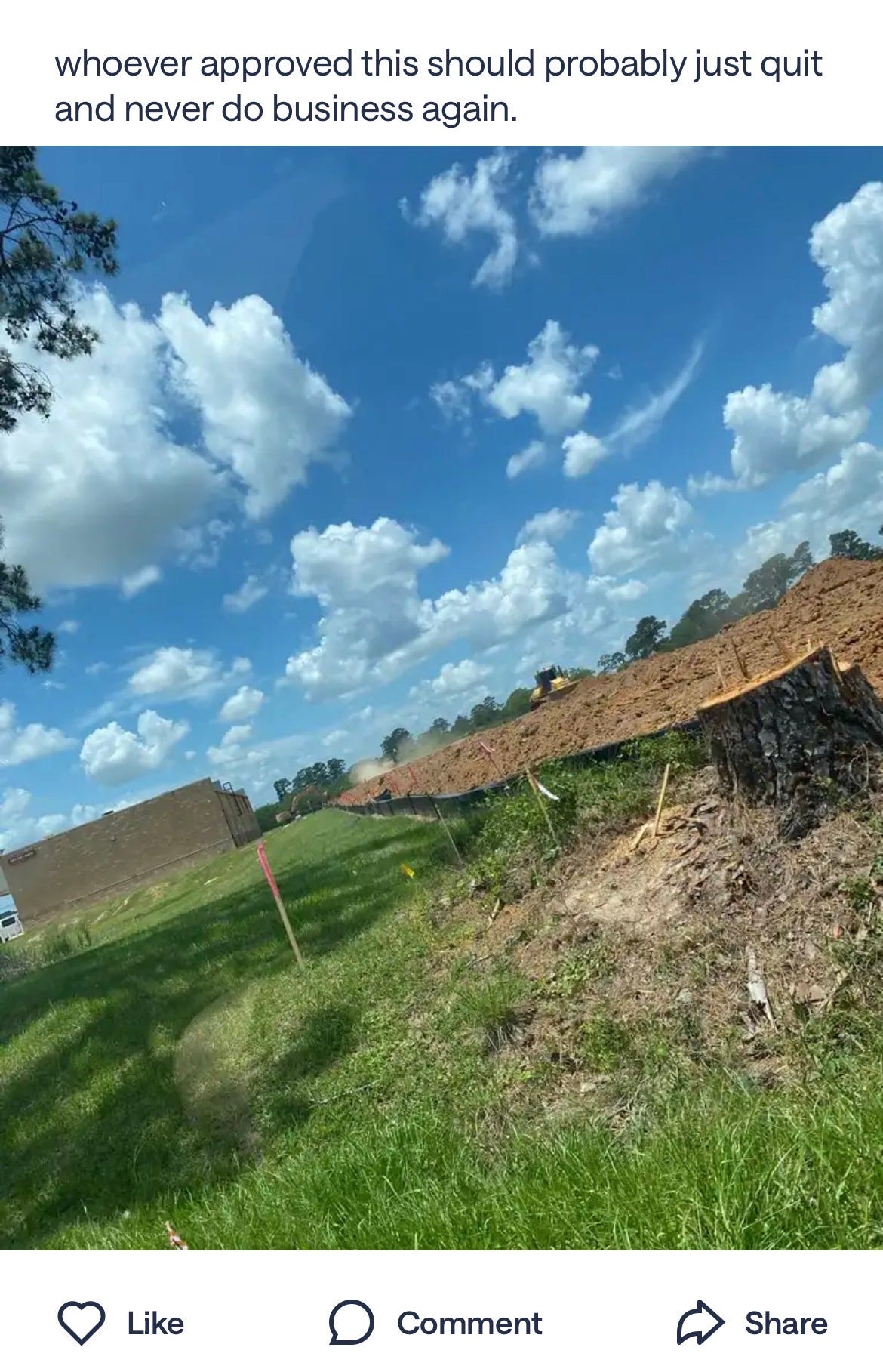
Later that evening my husband told me that the oak tree was a major topic of conversation on Nextdoor, an app that I have stopped using in the last few years because there’s only so much I want to know about the bizarre beliefs of the folks who live in this part of the county. Alas, I re-downloaded the app because I couldn’t resist reading comments about the oak tree and commiserating with fellow lovers of the oak. It only made me sadder, so I scrolled for ten or fifteen minutes before closing the app and removing it from my phone again. I will throw my fist up in rage every time I pass by this corner in the future.
There’s no reprieve for even a relatively old, quite stately live oak that would have functioned perfectly in a small subdivision park when the name of the game is to cram as many homes into a parcel of land as possible.
This is why I haven’t been able to write. There’s been too much to grieve: the past, the current, the future. I can write and document it but then it can easily disappear.
I know I shouldn’t expect anything other than a callousness from humans towards nature. I guess I keep looking for the good, being too optimistic.
So, that’s where I’m at right now. Keeping it tighter, closer to home. Not looking too far out and attempting to not give myself anxiety about all of the environmental catastrophes I cannot control. Which is hard when I drive around this state and see how quickly rural land is becoming suburban. Or how any kind of high-quality wild habitat is undergoing any form of habitat conversion. Don’t even get me started on realizing just how much has been lost due to grazing and drainage changes in the last 50-75 years.
It’s easier to not spin out when I can just push play on an audiobook and start ripping out taro.
Some nameless faceless designer/engineer likely specified “clear and grub,” without even knowing what was there. I’ve dealt with those types professionally, not with land developers specifically but with remediation projects.
That oak tree… no words.