

Argiope
Landscapes evolve and so do we.

My parents live in suburban Fort Worth and have been at this house since, well, it was either NYE 1985 or NYD 1986, I can’t recall which one is correct. I was five and in kindergarten when we moved into the house and I remember how little tree cover and vegetation there was at that time, pretty much an indicator of any new development in Texas, then and now. My parents planted out pecan and elm trees, little twigs that are now full-fledged trees that host squirrel families who pilfer pecans every year. Seeing the subdivision age over the last 40 years has been an interesting process as wildlife began really coming back into the picture in the last 15-20 years. There are reports of foxes and coyotes running the streets, hiding out in whatever lots are still undeveloped in the area, a common story across the country. And now raptors like Mississippi kites perch in those mature suburban trees planted by homeowners back in the 80s and early 90s. My mom took an interest several years ago to a few of those kites who would hang around for a while during migration and they became “her” birds every year when they passed through.
Part of me wonders how much of all of this was quietly existing in the suburban areas at that time but went unnoticed by me and everyone else, and the other part wonders how much was wiped out but has slowly been re-establishing in the decades since development. Starting in the early 90s, I was generally an environmentally conscious kid; there were a lot of Earth Day programs and proactive discussions about recycling and greenhouse gases back then. However, I was also terrified of spiders and insects and was typically in my own world, either reading books inside or, when I was outside, playing baseball in the front yard with neighborhood kids or riding my bike up and down the street. When I became a teenager I was in my own head and wrapped up in friends and crushes on boys; noticing Mississippi kites flying overhead wasn’t anywhere on my radar.
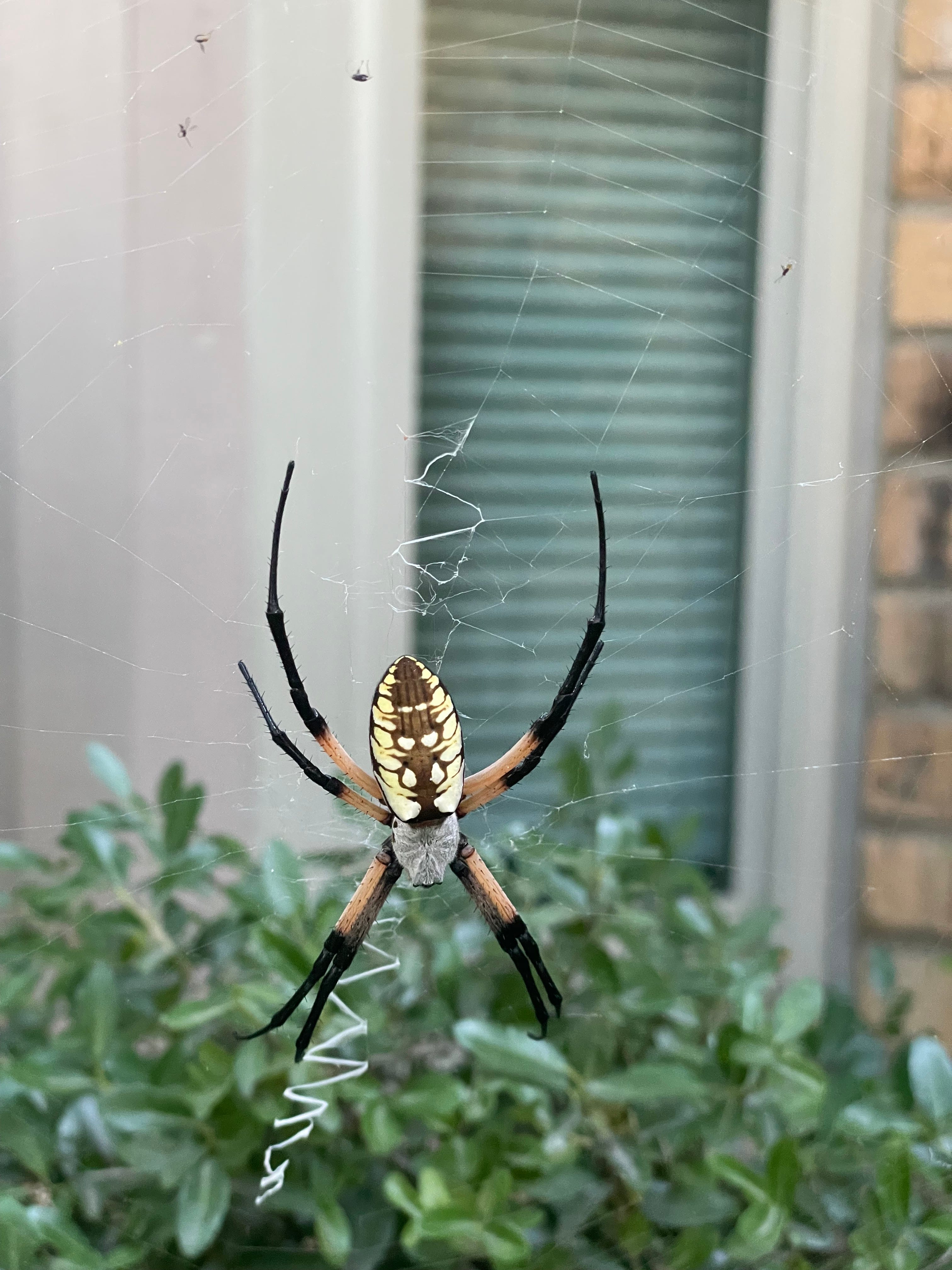
But, when my parents start finding interesting natural history bits in their own yard, my interest is always piqued. Take this yellow garden spider, Argiope aurantia, my dad found a few weekends ago when I was up there visiting. He came in from doing something outside and mentioned a large spider out front. Based on his description I immediately knew it was likely this species but went outside to check later just to be sure. This species did not exist in my parent’s yard from 1986-2002. I know it didn’t because I would have been terrified if I had seen it during that time period. A giant spider?! Someone kill it, please!
I recall, as a child, entering the hallway that led to all of our bedrooms and seeing a giant (to my child-sized eyes) daddy long legs spider on the wall and freaking out. I’m 100% sure my dad came in and killed it with a shoe or the newspaper. In hindsight, that scary spider was probably an Eastern Harvestman, Leiobunum vittatum, which are harmless arachnids unless you happen to be plants, fungi, and smaller arthropods.
Over the years, somehow I went from being terrified of insects and spiders (the annual spring crane fly explosion was also a traumatic event in our household) to having little chats with the jumping spiders that take up residence in tiny corners of my house. Sure, little friend, you can stay there, just let me sweep up this dust right here, I promise you can stay. And I talk to the spiders in the garden, too. Sorry, ma’am, just need to pull these weeds. Oops, didn’t mean to mess up your web!
Now, do I necessarily want Ms. Argiope Aurantia walking on me? Nope. I walked into many webs of her cousin(s), the Madame(s) Trichonephila Clavipes, when I lived in Florida. It’s the luck of being the first person to break a trail in the morning. When the light is just right sometimes you can’t see the web until it smacks you in the face. Next thing you know, you are laying on your back in the middle of the trail, stuck like a turtle with your pack on your back, flailing about and freaking out about a spider possibly crawling on your head!
There can be an evolution in understanding, going from the instinct to kill every insect in sight to befriending them, well, at least some of them. Is anyone really cozying up to mosquitoes and ticks? And alongside that evolution, we come to notice the natural world more, to see its interplay in our own backyards, whether they are suburban subdivisions or rural cabins.
The little bits of undeveloped land around my parent’s house are slowly being developed. A lot that had been empty for decades was cleared this past spring for townhomes. I’m biding my time to go up for a visit one weekend to find a gas station on the corner of another lot. Even if these empty lots aren’t truly wild in the way we imagine nature to be, they still serve as places for rainwater runoff to filter through before heading to the nearest creek, or serve as pollinator habitat with the mix of native and non-native wildflowers that pop up in the spring, if they aren’t mowed down before peak bloom. These edge spaces fill a niche, mini-wildlife corridors shuttling fauna of all shapes and sizes through to the islands of nature existing in the nearest cul-de-sac.
Eventually they bring in yellow garden spiders that build webs outside the childhood rooms of adults who love nature.
“The genus name Argiope was taken from Greek mythology and means “of the silver face,” while the species name aurantia basically means “overlaid with gold.”
Even though these references relate to colors, rather than precious metals, in my book Argiopes really are as good as gold.” - via Good Natured

Upon encountering an unfamiliar looking critter whilst tending to a plot I usually remark out loud something like " Hey dude, who are you ? " and after marvelling at this little mysterious creature for a while, I will then say something like "Have a good day" . I feel that these encounters with 'others' brings a richness to my day and a humbling as I realise once more how little that I know.
I love these! I've been admiring one in my garden every day, and was just processing photos of a beautiful Argiope aurantia that I saw at the end of my Sunday hike. I love learning what their and means, too.
I would have been terrified of them if we'd had them in Northern NJ. Instead, I remember being afraid every summer of an orbweaver (I think Neoscona arabesca) that would build a web near the house.
When we moved to GA in 2013, I remember being afraid of the yellow garden spiders but also appreciating their beauty. So much has changed!